
Kruba Baeng
Kruba Baeng (ครูบาแบ่ง ฐานุตฺตโม) of Wat Ban Tanot, Korat, born 1953 into a family of herbal healers, taught by a practitioner from Phu Khao Khwai in Laos; his 1994 first-batch seahorse-mould popularity birds number about 140.
Kruba Baeng (Kruba Baeng Thanutthamo, ครูบาแบ่ง ฐานุตฺตโม): profile
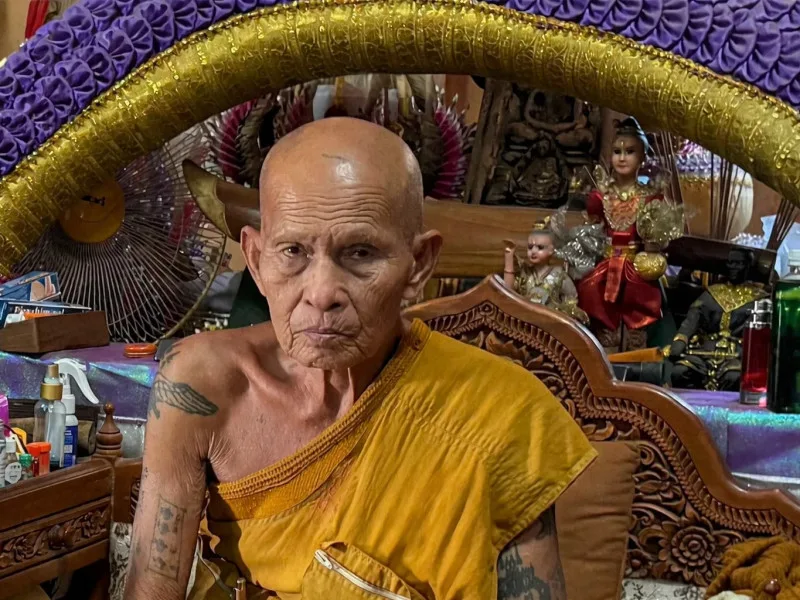
Kruba Baeng is the monk of Wat Ban Tanot (วัดบ้านโตนด) in Non Sung district, Nakhon Ratchasima (Korat), northeastern Thailand, known for the deity popularity bird (Thep Salika, เทพสาลิกา); Thai amulet websites call him "the originator of the Salika popularity bird". Born Sema Chumklang (เสมา จุ่มกลาง) in 1953 into a family of herbal healers, he studied as a young man with a white-robed practitioner from Phu Khao Khwai mountain in Laos, ordained twice, and has lived at Wat Ban Tanot since 2001.
| Thai name | ครูบาแบ่ง ฐานุตฺตโม |
|---|---|
| Lay name | เสมา จุ่มกลาง (Sema Chumklang) |
| Born | 15 August 1953 (BE 2496, a Saturday), Tanot subdistrict, Non Sung district, Korat |
| Ordination | First ordained 1978, left the robes 1980, ordained again 1993 |
| Temple | Wat Ban Tanot, Non Sung district, Korat |
| Sacred items | Deity popularity birds, Somdej, Khun Paen |
A family of herbal healers
A 2008 biography on the Thai amulet blog thaiamuletguru says his family had been herbal healers and ritual masters for generations, and he was the third of seven children. He finished primary school at the Wat Ban Tanot school at 12, then learned herbal medicine and chants from his father; by 14 he was already treating villagers, who called him "หมอน้อย", the little doctor.
Learning from a white-robed practitioner from Laos
Later a white-robed practitioner, Kruba Siharat (ครูบาสีหราช), came to the village from Laos across the Mekong. His practice was based on Phu Khao Khwai (ภูเขาควาย) mountain in Laos, in a lineage from Laos's Somdet Lun (สำเร็จลุน). Kruba Baeng practised austerities with him as a lay disciple and followed him up the mountain to learn. In 1978, at 25, he ordained at Wat Ban Tanot; his preceptor was Phra Khru Watcharayanwisut, head of the Non Sung district Sangha and abbot of Wat Dan Thonglang, and his monastic name was Thanutthamo. In 1980 Kruba Siharat died; he went up the mountain to arrange the funeral, and afterwards left the robes.
Ordaining again for his father
In 1993 his father had a stroke, and when nothing he had learned could cure him, he vowed to ordain for fifteen days and dedicate the merit to his father; once ordained, he decided to stay. The Thai "แบ่ง" (baeng) means "to share"; villagers saw that he helped everyone who asked and would share anything, so they called him Kruba Baeng. He went on practising in the forest, spent a rains retreat with his fellow disciple Kruba Krissana (ครูบากฤษณะ), settled at Wat Ban Tanot from about 2001, and became a Phra Khru in 2007.
The first batch of 1994
The blog says he first made sacred items in BE 2537 (1994), in three moulds: a three-tier Somdej; a single deity popularity bird, which disciples call the "seahorse" mould, about 140 pieces across three colours; and about 300 Khun Paen. Each later batch of popularity birds used different materials, and the numbers were small. Our source also records a story of him taking disciples to practise at Tham Phaya Nak (the Naga Cave) in Nam Nao, Phetchabun, in 1995 and bringing back "naga maiden powder" for the materials; this is a story told by the temple and the faithful, and we record it as such.
Kruba Baeng items in our shop
The BE 2537 first-batch popularity bird, "seahorse mould", in sacred powder and temple soil, in a sterling silver waterproof case. Every item in our shop comes with a permanent authenticity guarantee.
What is the "seahorse mould"?
It's the single popularity bird from Kruba Baeng's first batch of 1994. The bird's body curves, and disciples thought it looked like a seahorse, hence the name; Thai blogs write it ม้าน้ำ.
Is Kruba Baeng still alive?
We haven't seen any news of his passing. Our source saw him in person on a recent visit to Wat Ban Tanot, and says he is elderly now and spends less time receiving worshippers.