LP Liew BE 2539 Luang Pho Sothon Small Standing Figure (Copper, Waterproof Case, With Authentication Card)
A small standing figure of Lua…
LP Liew, the late abbot of Wat Rai Taeng Thong, Nakhon Pathom, famous for turtle king copper amulets, born into a Chinese family in 1905, passed away in 2000 aged 95.
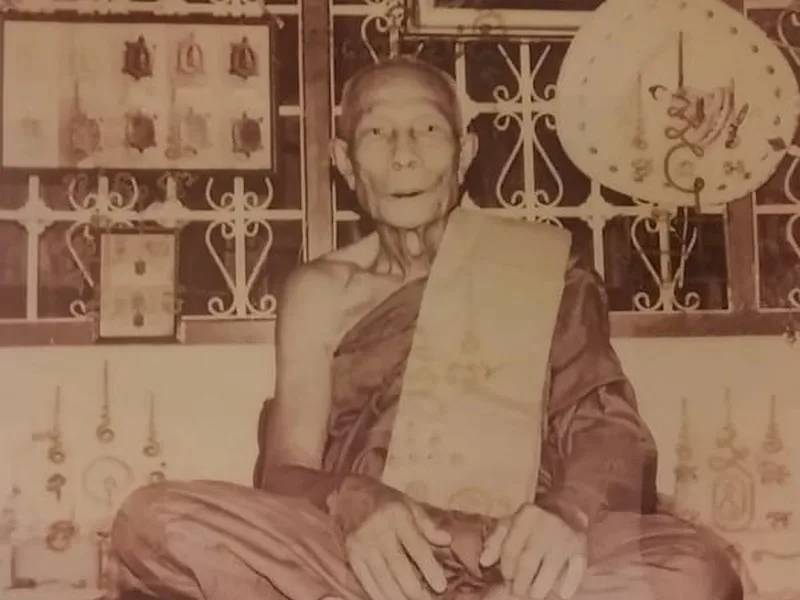
When Thais talk about wealth turtles, LP Liew is impossible to miss. He was the late abbot of Wat Rai Taeng Thong (วัดไร่แตงทอง) in Kamphaeng Saen district, Nakhon Pathom, and his turtle-shaped "Phaya Tao Ruean" copper amulets are his most famous items. Born on 7 December BE 2448 (1905), he passed away on 4 September BE 2543 (2000) at Wat Nong O in his home village, aged 95, after 74 years as a monk.
| Thai name | หลวงปู่หลิว ปัณณโก |
|---|---|
| Monastic name | Panako |
| Temple | Wat Rai Taeng Thong, Kamphaeng Saen district, Nakhon Pathom, Thailand |
| Born | 7 December BE 2448 (1905), Nong O village, Photharam district, Ratchaburi, into a Chinese family |
| Ordination | BE 2475, at Wat Bot, Ratchaburi |
| Best-known items | Turtle king copper amulets (Phaya Tao Ruean), Sangkajai, Phra Pidta, takrut |
According to Thailand's Khaosod, LP Liew was born into a Chinese family in Nong O village, Photharam district, Ratchaburi; as a boy he helped with the family's work and learned carpentry from his father. At 27, tired of worldly life, he ordained at Wat Bot, with the monastic name Panako.
After ordaining he sought out teachers everywhere, learning the practices of LP Daeng of Wat Khao Bandai It in Phetchaburi, Phor Than Khlai of Wat Suan Khan in Nakhon Si Thammarat and others. He then helped build several temples: he stayed thirty-six years at Wat Sanam Yae in Kanchanaburi and made it thrive, then founded Wat Sai Thong Phatthana in Dan Makham Tia district, Kanchanaburi. He lived simply, liking soft-cooked greens, bitter gourd and plain soup.
LP Liew explained the choice himself: he wanted to make a sacred item unlike the usual ones, and the turtle is long-lived and virtuous; in the Jataka tales, the Buddha in a former life was a great sea turtle. He first made turtle-shaped items around BE 2500, at first mostly powder amulets, and only later copper amulets, figures in the round and bucha statues. The first batch of turtle king copper amulets was issued at Wat Sanam Yae in BE 2516, with Sangkajai on the front and a yantra on the back, a design used ever since.
A Khaosod feature goes into more detail: LP Liew ordained in BE 2475 at Wat Bot in Photharam district, Ratchaburi, with LP Photha Phirom of Wat Bamrung Mueang as preceptor. After ordaining he lived at Wat Nong O in his home village; besides studying with LP Daeng of Phetchaburi and Phor Than Khlai of Nakhon Si Thammarat, he also learned from LP Um of Nakhon Sawan. In BE 2481–2482 he studied scripture at Wat Nong O, but after only five months of elementary Buddhist studies he had to go and help build a preaching hall at Wat Khok in Suphanburi, then helped build monks' lodgings and an ordination hall at an abandoned temple in Ban Tha Sao, returning to Wat Nong O only when they were finished.
In BE 2484 he was invited to Kanchanaburi to restore Wat Sanam Yae, and stayed thirty-six years; he then spent five years building Wat Sai Thong Phatthana in Chorakhe Phueak subdistrict, Dan Makham Tia district. His lodging had almost nothing in it, and every meal was soft-cooked greens, bitter gourd, mild chilli paste and clear soup; he also loved chewing betel.
The turtle king (Phaya Tao Ruean) comes from a Jataka tale: in a former life the Buddha was a great sea turtle named Maha Chittachun, living on an island. A sailing ship sank in a storm, and the survivors, stranded on the island and starving, wanted to kill the turtle to eat. Taking pity on them, the great turtle rolled down from the hill himself so they could eat his flesh, then use his shell as a boat to get home. Later these people drew the great turtle's image to worship, and the Thai tradition of turtle-shaped sacred items comes from this.
According to reports, LP Liew began making turtle-shaped items at Wat Sanam Yae around BE 2500, early on mostly powder amulets, and later coins, figures in the round, bucha statues, Sangkajai and Phra Pidta, plus waist takrut, two-tailed geckos and other charms. His most famous turtle king coin he learned from LP Yon of Wat Ban Khong in Ratchaburi. The first batch came out at Wat Sanam Yae in BE 2516: a four-legged turtle with ears on its head, Sangkajai on the front and a yantra on the back; only 300 were made in nine-metal bronze, given to donors of the preaching hall's pillars, and 12,000 in red copper. Local lore says the coins were soaked in a jar of holy water for blessing, and only given out once every "turtle" had crawled out of the jar.
In mid-BE 2543, LP Liew fell ill with age. He had long told younger monks that he was born in Nong O and wanted to die in Nong O, and that when the time came they needn't try to keep him. At 8:35 pm on 4 September that year, he passed away peacefully at Wat Nong O, aged 95, after 74 years as a monk. Today worshippers at Wat Rai Taeng Thong still crawl under the great turtle statue, praying for illness to leave them and for long life.
The BE 2536 wealth turtle "Ruay Ruay Ruay", a red copper turtle amulet from the batch for the monk's 88th birthday, one in a silver case and one in a gold case. Like every item in our shop it carries a permanent authenticity guarantee: if a recognised authentication body judges it a copy, the full offering is refunded.
Yes. The Thai หลิว (Liew) is rendered in Cantonese in a couple of different ways in Hong Kong; all refer to Luang Pu Liew Panako of Wat Rai Taeng Thong.
The temple has a huge turtle statue, and worshippers crawl under its body, said to drive away illness and bring a long life like a turtle's.
Besides the turtle king copper amulets, he also made Sangkajai, Phra Pidta, figures in the round, and charms such as waist takrut and two-tailed geckos.