LP Kuay
LP Kuay (หลวงพ่อกวย ชุตินฺธโร) of Wat Kositaram (Wat Ban Khae), Chai Nat, born 1905, passed away 12 April 1979, famous for his "Hanuman raising the flag" sak yant.
LP Kuay (Luang Pho Kuay Chutintharo, หลวงพ่อกวย ชุตินฺธโร): profile
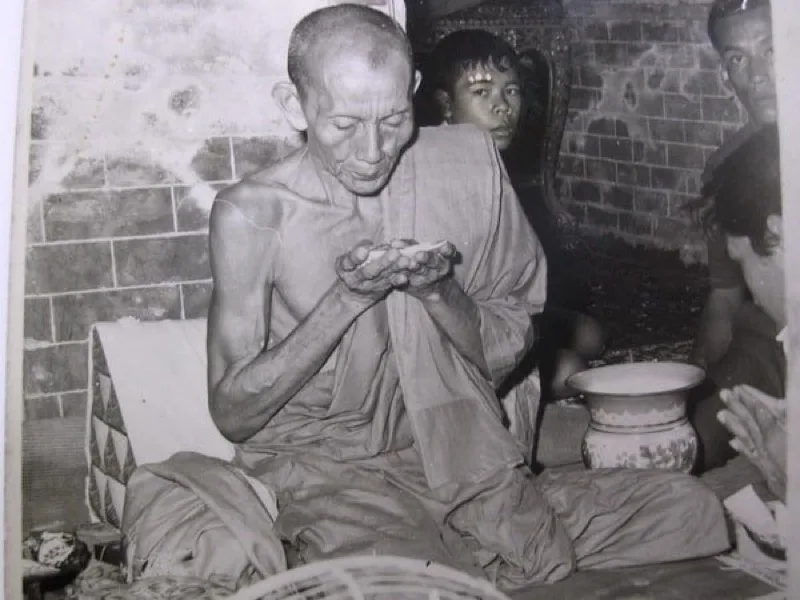
LP Kuay was a monk of Wat Kositaram (วัดโฆสิตาราม, commonly called Wat Ban Khae, วัดบ้านแค) in Sankhaburi district, Chai Nat. According to Thailand's Khaosod, he was born in Ban Khae on 2 November BE 2448 (1905) and passed away on 12 April BE 2522 (1979), aged 74, after 54 years as a monk. He was famous in his day for sak yant, especially the "Hanuman raising the flag" (หนุมานเชิญธง) yant.
| Thai name | หลวงพ่อกวย ชุตินฺธโร |
|---|---|
| Lay name | กวย ปั้นสน (Kuay Pansorn) |
| Temple | Wat Kositaram (Wat Ban Khae), Bang Khut subdistrict, Sankhaburi district, Chai Nat |
| Born | 2 November BE 2448 (1905), Ban Khae, Chai Nat |
| Ordination | Fully ordained at Wat Bot, Sankhaburi district, on 5 July BE 2467, monastic name Chutintharo |
| Title | Raised to Phra Khru on 5 December BE 2511 |
| Passed away | 12 April BE 2522 (1979), aged 74, 54 rains retreats |
Childhood and ordination
LP Kuay's lay name was Kuay; as a boy his mother sent him to Wat Ban Khae to study with the temple's old monk. At 20 he was fully ordained at Wat Bot in the same district, with the monastic name ชุตินฺธโร, then returned to live at Wat Ban Khae, learning to preach the Vessantara Jataka. Later he learned traditional medicine from local healers, treating villagers for epidemics and smallpox.
Who he learned from
In BE 2472 he went to Wat Phra Prang in Sing Buri to learn meditation, magic and the making of protective items from LP Si (หลวงปู่ศรี); in 2477 he moved to Wat Nong Khaem to study medicine further. Later, at Wat Bang Ta Ngai in Nakhon Sawan, he learned to make armbands, takrut and ritual knives from LP Doem (หลวงพ่อเดิม) of Wat Nong Pho. Khaosod also records a story: while he was at Wat Nong Khaem, a monk found an old manual of magic in a hollow tree; he lit incense to inform the spirits and vowed to use it only for the good of the temple and all beings before he took the manual back.
Sak yant in the Second World War
During the Second World War he returned to Wat Ban Khae and gave sak yant to disciples day and night. Bandits were rife in central Thailand then, and villagers left their belongings at the temple, relying on the monk's reputation to keep them safe. Old locals say bandits passing Wat Ban Khae would fire a shot in salute. His most famous yant is "Hanuman raising the flag"; the Hanuman-back coins issued when the temple's boundary was consecrated in BE 2521, about twenty thousand of them, are very hard to find today.
From Wat Khwit to Wat Kositaram
According to Thai Wikipedia, the temple was originally a small abandoned temple in the forest, called Wat Khwit because it stood on high ground covered in wood-apple trees (Ma Khwit), with just two thatched lodgings; older villagers called it Wat Ban Khae after the village. LP Kuay was its sixth abbot from BE 2491 to 2522, and in his time renamed it Wat Kositaram; Wikipedia suggests this was because he made amulets in the style of Somdej Toh of Wat Rakhang Kositaram (this is a suggestion, not a settled fact). Thailand's National Office of Buddhism records the temple as founded in BE 2360, granted ordination hall land on 1 July 2517, with the hall completed around 2518 and the boundary-stone ceremony held in 2521; the BE 2521 Hanuman-back coins often mentioned in shops were issued at that boundary consecration.
The temple's sacred pond
The temple has a pond LP Kuay dug himself; he cast magic into it, and used to throw amulets and some amulet moulds into it to make the water more potent. To this day worshippers take its water as holy water, and the earth around the pond has been used to make amulets. The temple's principal Buddha is a stucco Luang Pho To, its hall's base inscribed as built in BE 2473. LP Kuay's successors as abbot were Phra Athikan Samruai (2522–2535) and Phra Khru Kositphatthanakhun (from 2535).
LP Kuay items in our shop
The BE 2515 Sangkajai (wealth Buddha), temple soil and sacred powder, blessed in the monk's lifetime, in a sterling silver waterproof case, with authentication card. Every item in our shop comes with a permanent authenticity guarantee.
Are LP Kuay and หลวงพ่อกวย the same monk?
Yes. In English the Thai กวย is usually LP Kuay, and Hong Kong sellers have their own Cantonese rendering; all refer to this monk of Wat Kositaram, Chai Nat.
Is there a yearly day in LP Kuay's memory?
Yes. Wat Kositaram and his disciples hold their yearly merit-making day on 12 April, the day he passed away.
LP Kuay BE 2515 Phra Sangkajai Wealth Buddha (Temple Soil and Sacred Powder, Sterling Silver Case, Certificate Card)
A Phra Sangkajai (wealth Buddh…