
LP Tim Attasanto
LP Tim Attasanto (หลวงปู่ทิม อตฺตสนฺโต), "Fat Tim" to Hong Kong collectors, former abbot of Wat Phra Khao, Ayutthaya, 1914–2009, known for betel-residue Look Om and wealth fish. His life, teachers and our items.
LP Tim Attasanto (Luang Pu Tim Attasanto, หลวงปู่ทิม อตฺตสนฺโต): profile
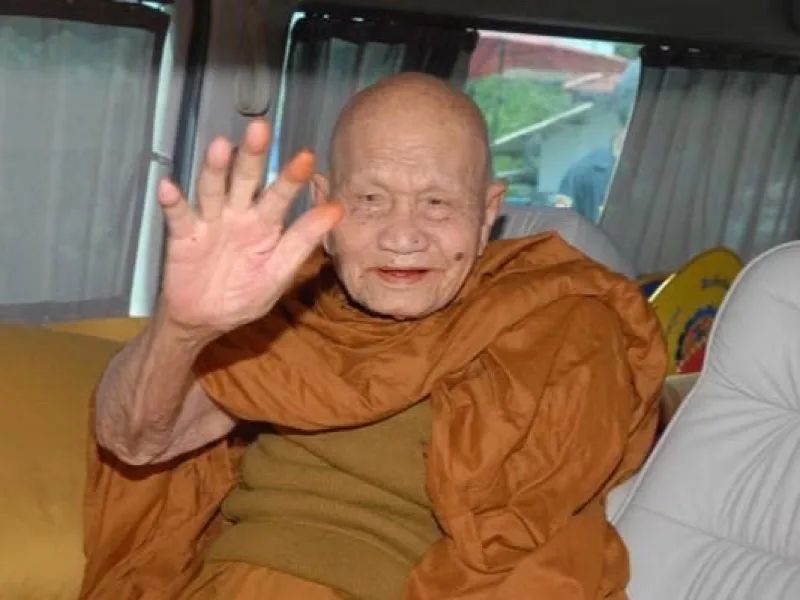
Hong Kong collectors nickname this LP Tim "Fat Tim". He was the former abbot of Wat Phra Khao (วัดพระขาว) in Bang Ban district, Ayutthaya, best known for Look Om made from betel residue (ลูกอมชานหมาก) and wealth fish. He shares a name with LP Tim (LP Tim Issariko) of Wat Lahan Rai, Rayong, but they are two different monks.
| Thai name | หลวงปู่ทิม อตฺตสนฺโต (พระครูสังวรสมณกิจ) |
|---|---|
| Lay name | Tim Chumchokdee (ทิม ชุ่มโชคดี) |
| Born | Sunday 1 March BE 2456 (old calendar, i.e. 1914), Bang Ban district, Ayutthaya |
| Passed away | 22 March 2009 |
| Temple | Former abbot of Wat Phra Khao, Ayutthaya |
| Title | Phra Khru Sangwon Samanakit (conferred 1969) |
| Teachers | LP Sam, LP Chong of Wat Na Tang Nok, LP Sod of Wat Paknam |
His life
According to Thailand's Khaosod, his lay name was Tim Chumchokdee, and he was born in the Phra Khao area of Bang Ban district, Ayutthaya. As a young man he finished fourth grade and helped his parents farm, later did military service, and ordained after his discharge. On 10 April 1948, at 35, he was fully ordained again in his home district, with the monastic name Attasanto.
In 1957 he passed the highest level of the Dhamma examinations; in 1967 he became subdistrict Sangha head and a preceptor, and in 1969 received the title Phra Khru Sangwon Samanakit. As abbot he renovated the temple's lodgings and built a preaching hall. He liked to meditate alone in cemeteries, lived simply and kept the precepts strictly.
Teachers and sacred items
According to Khaosod, he studied with his ordination preceptor LP Sam, with LP Chong of Wat Na Tang Nok, and with LP Sod of Wat Paknam in Bangkok. He made many kinds of sacred items: his most famous betel-residue Look Om, gold and silver wealth fish, Khun Paen, Phra Kring and monk image commemorative coins, mostly for popularity, good luck and wealth. He passed away in a hospital in Nonthaburi on 22 March 2009.
His passing and incorrupt body
A 23 March 2009 report on Thailand's Sanook says that in his last years he was often in and out of hospital; on 13 March he left hospital specially to preside over the temple's annual fair, and the next day could no longer eat and had trouble breathing, and was taken to the Central Chest Institute in Nonthaburi. The director said he had a severe blood infection and pneumonia, and he passed away at 10:55 am on 22 March, aged 96. A Komchadluek report the same year gives the date as 21 March, a day off from Sanook's; we follow the same-day report's 22 March, and list both dates.
Komchadluek reported on 29 June 2009 that before the hundredth day, the temple opened the coffin to check and found his body had not decayed and was still soft. On 30 June the body was moved into a glass coffin he had bought in advance in 1995, then placed in the Mondop Lai Rot Nam he had paid for in his lifetime, so that worshippers could pay respect every day, as he wished. When the coffin was opened, the temple also took out two commemorative coins that had been placed inside, "91 years long life" and "8 zodiac cycles (96 years)", 9,500 sets in all, with the proceeds going to build an assembly hall for the temple school.
LP Tim Attasanto items in our shop
The BE 2549 "Thawi Lap" square portrait coin with Phra Sivali back, red copper, about 4.3 cm tall, in a sterling silver waterproof case, with authentication card. Every item in our shop comes with a permanent authenticity guarantee.
Are "Fat Tim" and "Crooked-head Tim" the same monk?
No. These are Hong Kong collectors' nicknames. "Fat Tim" is the LP Tim of Wat Phra Khao, Ayutthaya; "Crooked-head Tim" is the LP Tim of Wat Lahan Rai, Rayong, who passed away in 1975 and is known for Phrai Kuman powder.
What year was he born?
Thai sources give Sunday 1 March BE 2456. Thailand's new year was then in April, so this converts to 1 March 1914, which was indeed a Sunday.