
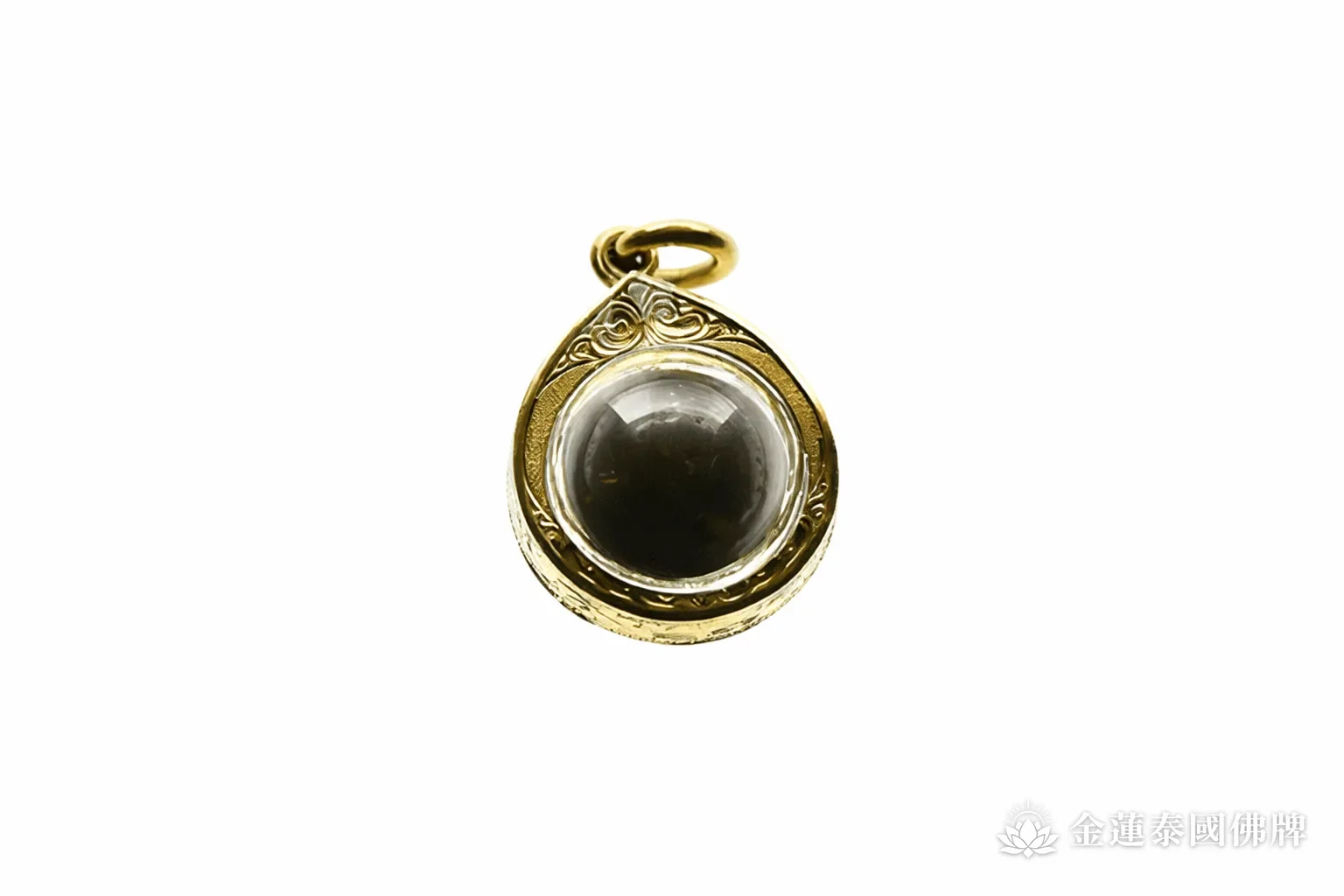
A Mekhasit Luk Om (Luk Om Nuea Mekhasit) blessed between BE 2455 and 2465 by Luang Pu Thap (หลวงพ่อทับ) of Wat Anongkharam, Bangkok, now over a century old. About 2 cm tall, in a 90% gold waterproof case, with authentication card.
Details
| Blessed by | Luang Pu Thap (หลวงพ่อทับ), per the seller |
|---|---|
| Temple | Wat Anongkharam (วัดอนงคาราม), Bangkok |
| Name | Mekhasit Luk Om (Luk Om Mekhasit) |
| Year | Between BE 2455 and 2465 (about 1912–1922) |
| Material | Mekhasit |
| Size | About 2 cm tall |
| Case | 90% gold waterproof case |
| Authentication | With authentication card (for how to check it, see What is an amulet authentication card?) |
| Benefits | Protects and guards the wearer’s body, wards off all bad luck and disaster, brings popularity and help from benefactors |
| Price | US$2,426 (with 90% gold case and authentication card) |
Want to know the monk who blessed this piece? Read the Luang Pu Thap Wat Anong profile ›
This Luk Om
A round metal bead set in the centre of a teardrop-shaped 90% gold case, visible through the domed clear front. Mekhasit is blackish grey with a hint of golden green, its surface showing fine pitting and wear, with a dull sheen in the light. The gold case is engraved with scrolling floral patterns around the edge, and the loop is gold too. The photos show the two pieces we have; the cases’ patterns differ slightly.
Mekhasit and Luang Pu Thap
Mekhasit, like Mekhaphat, is an alloy recorded in old Thai texts, smelted again and again from many metals and minerals, and little was made, so it’s hard to come by. Thais believe it turns bad luck to good, and some say that after absorbing bad luck its colour turns from golden green to black, changing back after a while. According to the seller, Luang Pu Thap was born around 1846 and passed away in 1937, a master of alchemy and chants; his Luk Om fuse dozens of metals and fragments of old amulets and of old Buddha images from the temple, cast with chanting over and over for nearly a year, and Thai collectors call them the king of Luk Om. They also go well with deity amulets such as Rahu and the Four-Faced Brahma.
Note: he is not the same monk as our LP Thap of Rayong; they just share a Thai name. A Posttoday amulet column says Mekhasit is smelted from silver, zinc, copper and mercury, and that Luang Pu Thap also cast it into Luk Om; few records of his life survive, see the Luang Pu Thap profile. Our other takrut and Luk Om are in the Takrut & Look Om section.
Frequently asked questions
How is a Luk Om different from an amulet?
A Luk Om fuses chants and sacred materials into a single bead, with no image, and is worn more freely; see How is a takrut different from an amulet?
Why is it so expensive?
It’s a Luk Om over a hundred years old, Mekhasit itself was made in small amounts, and it comes with a 90% gold case; it has always been much sought after by Thai collectors.
What’s the authentication card for?
The card carries a photo and number you can check on the issuing body’s website; see What is an amulet authentication card?
Can I wear it with other amulets?
Yes; a Luk Om usually hangs beside the amulet. For how to arrange them, see How many amulets can you wear at once?; for metal materials, see Amulet materials.