
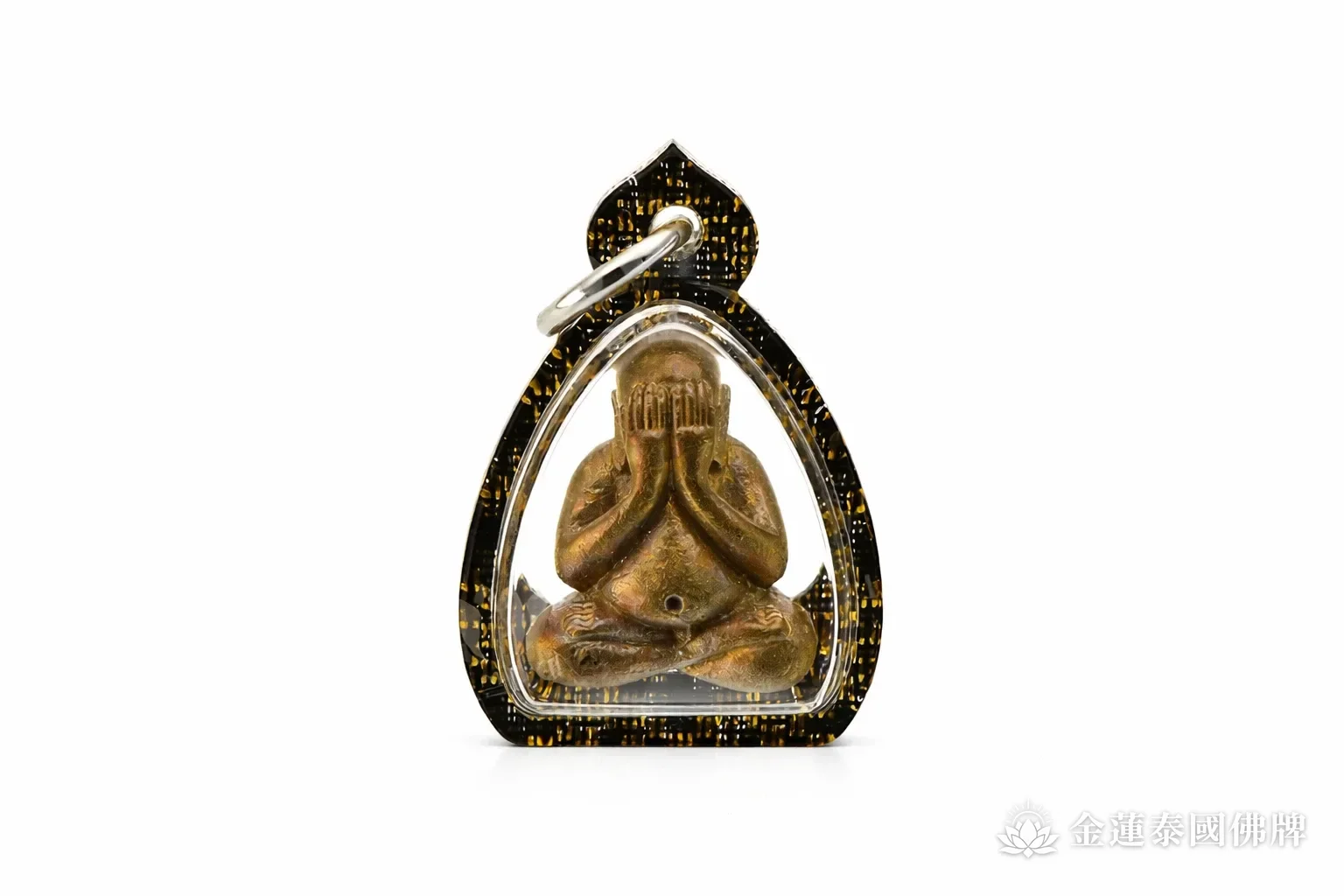
The first-batch Phra Pidta made in BE 2539 under LP Thong (Luang Pu Thong, หลวงปู่ทอง สุสังวโร) of southern Thailand. The batch is called “Rub Sap” (รับทรัพย์), meaning “receiving wealth”. Cast in old bell metal, about 3 cm tall, in a waterproof case, with a certificate card.
Amulet details
| Made under | LP Thong (Luang Pu Thong Susangwaro, หลวงปู่ทอง สุสังวโร) |
|---|---|
| Temple | The seller gives Wat Pako Suwannaram (southern Thailand) |
| Name | First-batch Phra Pidta “Rub Sap” (รับทรัพย์) |
| Year | BE 2539 (1996), first batch |
| Image | Phra Pidta covering his face with both hands, seated cross-legged, a small hole at the navel, a line of Thai engraved on the back of the base |
| Material | Old bell metal |
| Size | About 3 cm tall |
| Case | Waterproof case, black with gold-dotted edging |
| Certificate | Certificate card included (how to check it: see What is an amulet certificate card?) |
| Benefits | Smooth career and thriving business, helping wealth gather, protection from gossip, shielding from evil and accidental harm |
| Price | US$101 (including waterproof case and certificate card) |
This Phra Pidta
The figure is plump, both hands covering the whole face, every finger clearly visible, legs crossed. There’s a small round hole at the navel. The surface is brass with a reddish tone, covered in fine lines, the skin of melted and cast bell metal. The back is round and plain, and a line of Thai runs round the base. The case is black with gold dots.
“Rub Sap” and bell metal
The Thai รับทรัพย์ means “receiving wealth”, so this is a wealth Phra Pidta. According to the seller, it was cast from metal melted down from old temple bells; Thais believe a bell’s sound carries far, so items made from bell metal also carry the meaning of a far-reaching name and gathering wealth. For why Phra Pidta covers his face and how the different ways of covering differ, see Why does Phra Pidta cover his face?
About LP Thong
The seller says LP Thong was a senior monk of the Songkhla area in southern Thailand, born in BE 2451 and passed away in 2543 aged 92, and that this is his first-batch Phra Pidta. The source page isn’t consistent about the temple, and we haven’t found him in the Thai press, so the above is given as the seller wrote it, for reference.
Other monks’ Phra Pidta are in the Phra Pidta section.
Frequently asked questions
What is the small hole at the navel?
It’s a hole left from casting; some Phra Pidta have sacred materials sealed in through it or the base. This one is already sealed and needs nothing done.
What’s on the certificate card?
Usually a photo of the amulet, the monk and batch name and a verification number, which you can check on the issuer’s website; see What is an amulet certificate card?
Can I wear Phra Pidta with a Phra Somdej?
Yes. The Phra Somdej usually goes in the middle and the Phra Pidta to the side; see How many amulets can you wear at once?